
Things to Do in Dublin
Dublin, Dublin… While I start writing by drawing inspiration from the song “Bodrum Bodrum,” with its ringing similar to “Bodrum Bodrum,” there’s absolutely no resemblance between Dublin and Bodrum:) First of all, with its almost instantaneously changing weather, I can say it’s a bit of a bipolar city. The rapidly moving clouds driven by the strong wind are the main cause of this change. While you’re happily wandering around under the sunshine, the sudden downpour that starts 10 minutes later can take away all your motivation as you search for shelter. Fortunately, the changes are brief, so when you see the rain, just find a place to take cover like the Dubliners and wait for it to pass. The confusion caused by the weather is also reflected in the Dubliners’ clothing. You might see them carrying raincoats or cardigans while wearing flip-flops or sandals on their feet:)
Dublin was the final stop on our Scotland-Ireland tour. Our expectations were high, but we didn’t really know what to expect. Not having done thorough research before coming certainly played a big role; I guess this is what they mean by going with the flow.
Places to Visit in Dublin
Our first stop in Dublin was Trinity College. Trinity College is most famous for its library (Book of Kells). Despite the entrance fee, there’s such a long line that you wonder if you’re missing out on something. Fortunately, from what we heard from those who entered, there’s nothing more than what you see in the photos. The fact that this library was used in a Harry Potter movie might increase interest, of course, but I don’t think that’s the most important feature of Trinity College. Until 1970, it was an educational institution with a ban on Catholics, only open to Protestants; just imagine, 1970 is such a recent date.
Another significant point in Trinity College is the “Sphere Within Sphere” sculpture by Pomodoro. The first of these sculptures was made in the Vatican, and when you look at it from one side, it appears very smooth, but on the other side, there’s a crack, and you can see another sphere emerging from it. There are different interpretations of what the sculpture represents, ranging from everything having a fragile side to the elites enslaving a fractured world. Pomodoro, however, says the outer layer represents Christianity and the inner layer represents the world. My view is that works of art should be left to everyone’s own interpretation, just as when a songwriter doesn’t say, “I wrote this with this intention, so listen with the same feelings and thoughts,” the same should apply to sculptures and other works of art.
Another thing that impressed me here was seeing a quote from Emmeline Pankhurst, the leader of the “Suffragette” movement, whose film I had watched recently: “If we win this, the hardest of struggles… it will be much easier in the future for all the women in the world to win their own battles when the time comes.”
Our second stop, as always, was the famous shopping street; Grafton Street. This street, filled with stores and malls in its side streets, reminds me of the old days of Istiklal; as you might guess, it’s quite crowded.
At the end of the street is our favorite place in Dublin; St Stephen’s Green. When I see a park, leave me there to wander for hours; of course, I can’t compare it with the ones in London, but it does remind me of St James Park. If you have food with you and you’re not afraid, put some crumbs in your palm and wait for the pigeons to come and land on your arm or head. Though when you add seagulls and all the other birds, they can get a bit intimidating. This place is ideal for relaxing, finding peace, and escaping the city’s hustle and bustle.
After leaving St. Stephen’s Green and walking a bit, you’ll come across colorful doors. When Queen Victoria died, it was decided to paint the doors black as a sign of mourning, but the Irish, who didn’t want English rule, decided to paint their doors in bright colors instead. Another popular interpretation is that they painted them this way to easily find their doors when they got drunk.
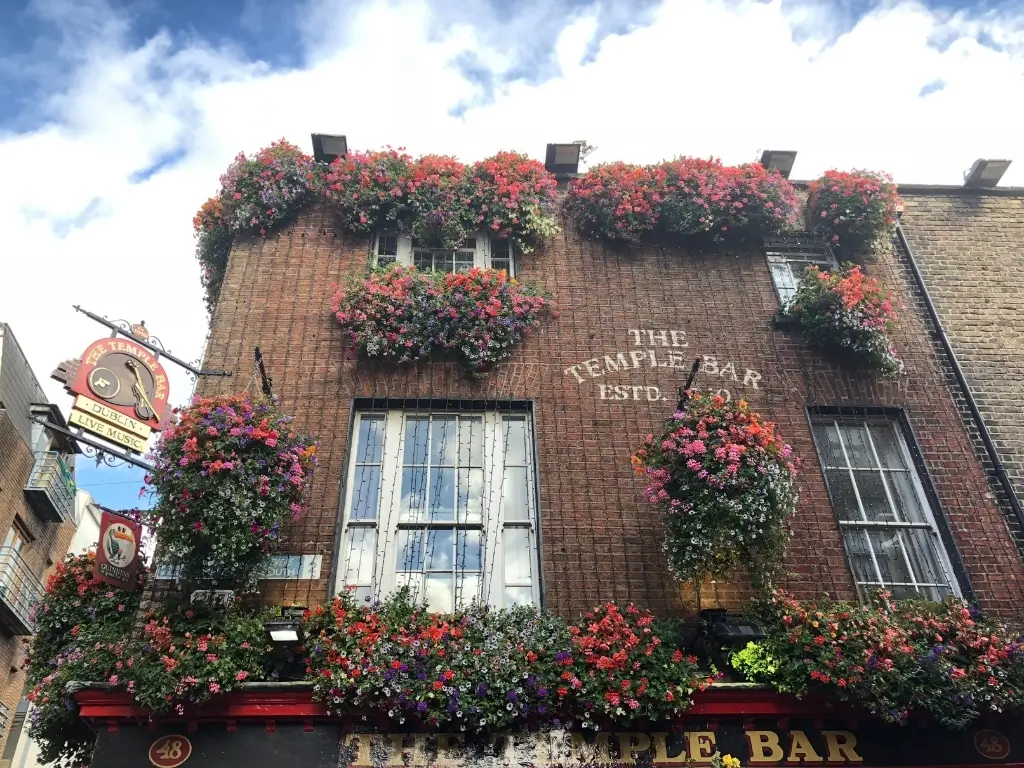
The most popular spot for tourists in Dublin is undoubtedly Temple Bar. Everyone outside is searching for a good angle to take a photo. Inside, there’s live music all day long; even if you don’t drink anything, I’d say go in and take a look.
Another enjoyable activity in Dublin is walking along the Liffey River when the sun is shining. Don’t forget to visit the Ha’Penny Bridge, the first bridge built for pedestrians here, while you’re walking. Before this bridge, people used to cross by boat, but when the boats got old, the operator Walsh decided to build a bridge instead of repairing the boats. Those crossing the bridge, which replaced the boats, were charged half a penny (Ha’penny). Over time, the name of the bridge became Ha’penny because of the fee. Also, you can continue shopping on the other side of the bridge.
One of the activities to do during rainy weather is to visit the National Gallery, which has free entry. Inevitably, I compare it with other galleries I’ve visited, and it does fall a bit short, but the mural on the inner wall is worth seeing.
We didn’t want to go and spend money at the Guinness Brewery because I’m not a fan of beer. Those who went loved it, and even if you don’t drink beer, they said you should go, but the decision is yours. Also, as seen in the cover photo, Heineken, despite not being an Irish brand, has tried to make itself stand out in this pub paradise.
There’s also the Molly Malone Statue on Suffolk Street. This woman, who was both a fishmonger and a prostitute, was loved by the people, so after she died, a statue was made of her. There are also rumors that touching her breasts brings luck and that her ghost roams the city. There’s even an Irish song about Molly Malone (Cockles and Mussels).
The only place we missed out on in Dublin was Phoenix Park, which is a bit far from the city center and quite large; we were really eager after seeing photos taken with the deer there, but we ran out of time. Fortunately, from what we heard from those who went, it’s not always possible to see deer.
Lastly, our guide recommended we go to the River Dance show, which is the origin of Anadolu Ateşi (an Anatolian dance group=, but with the rising exchange rates, the ticket prices were too steep, so I’d rather see Anadolu Ateşi.
Transportation in Dublin
It might be more accurate to name this section “Traffic in Dublin.” I didn’t expect it at all, but there’s a lot of traffic in Dublin, especially during rush hour. The public transportation network isn’t very developed either. The trams are crowded. I’d recommend walking around Dublin.
Also, if you happen to encounter an important event like the Pope’s visit, as we did, some roads might be closed, so it’s good to keep track of these and take precautions accordingly.